
Here's what you need to know before you book: junk removal typically runs between $75 and $600 or more, and the gap between those numbers comes down to five things. Load size. What's in the load? Where you are and how easy the items are to reach. When you need the pickup. And how much work the crew has to do once they're there.
This guide walks through each of those factors so you know what to expect when you book junk removal and get your quote — and so nothing surprises you at the door.
TL;DR Quick Answers
How Do I Book Junk Removal?
Type your ZIP at jiffyjunk.com/booking, pick a pickup window, and a licensed White Glove crew is confirmed. The whole thing takes about 60 seconds. The quote you see is the quote you pay — no callbacks, no surprise fees at the door.
Top Takeaways
Junk removal typically costs $75–$600 or more, with the national average around $242 per load. Full truckloads of heavy or mixed debris can push past $700.
Load volume drives the price more than anything else. Most companies price by truck space used, not item count.
Appliances, mattresses, and e-waste carry disposal surcharges that standard furniture doesn't. Know what's in your load before you call.
Access and location move the number. Stairs, tight corridors, and high-cost urban markets all push quotes higher. Curbside-ready loads cost the least.
Same-day pickup typically adds a 10–25% premium. Book 24–48 hours ahead when you can.
A photo inventory before you call gets you a more accurate first quote. It's the single most useful thing you can do before you book.
Online appointment scheduling tools let you pick your date, see real pricing, and confirm without phone tag.
What Goes Into a Junk Removal Quote?
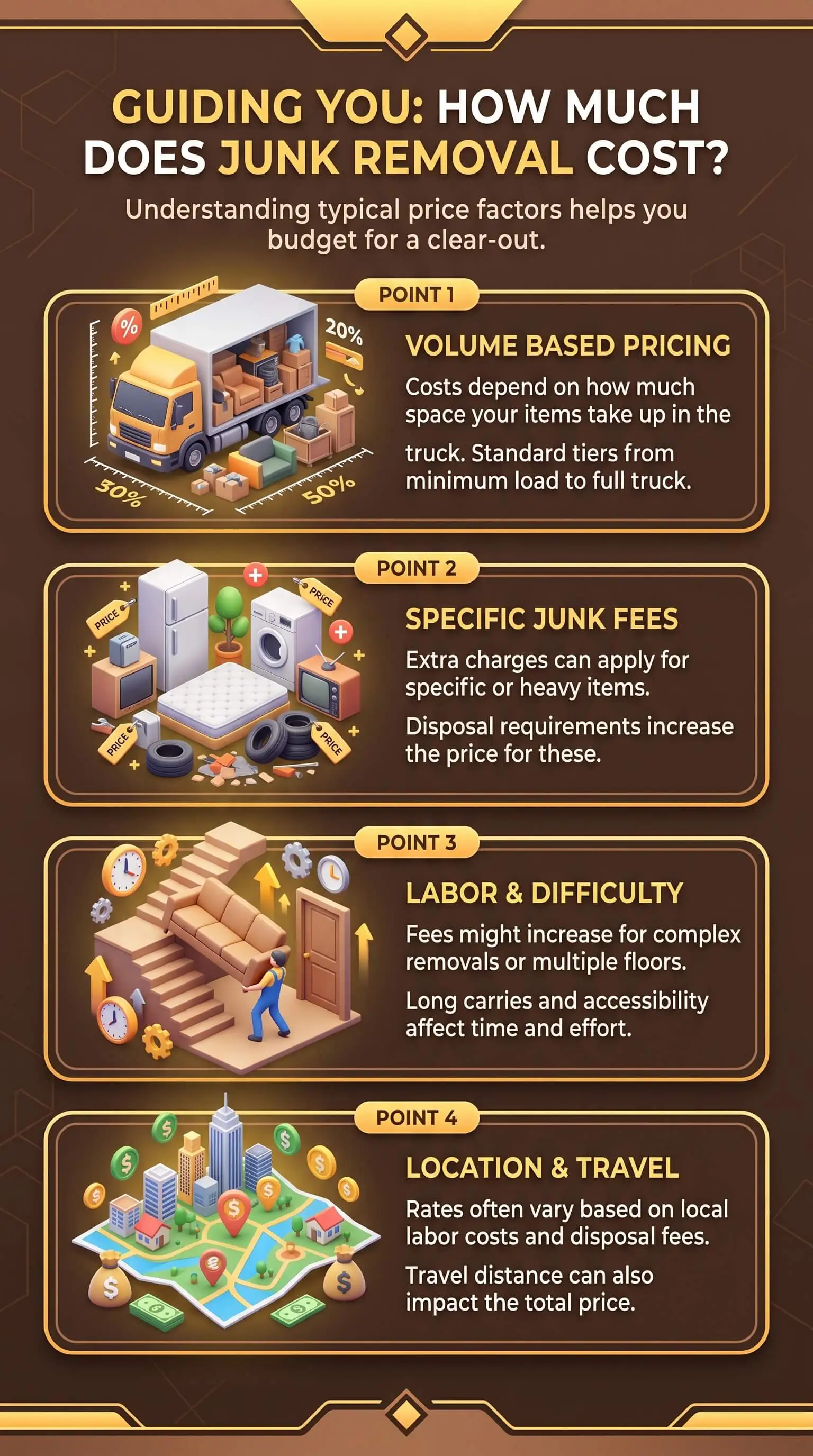
Every quote reflects real operational costs: disposal fees, fuel, labor, and truck capacity. Five factors consistently push that number up or down.
Volume and Load Size
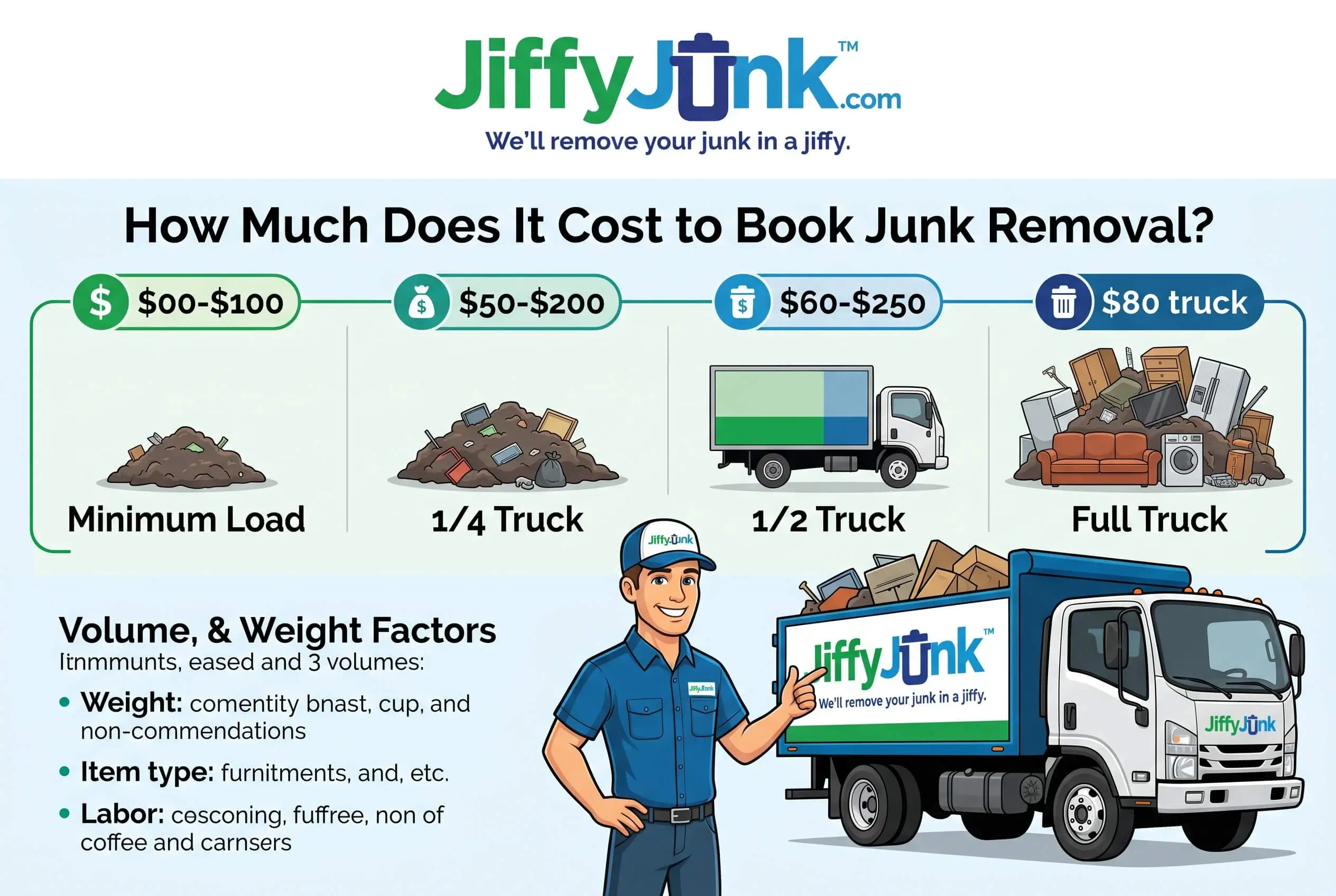
This is the biggest one. Most junk removal companies price by how much of the truck your items fill — not by item count, not by weight alone. A standard junk removal truck holds roughly the equivalent of six full pickup truck beds of debris.
Here's what that looks like in dollars:
Minimum load (1/8 truck or less): approximately $75–$150. A few boxes, a single appliance, a small piece of furniture.
Quarter-load: approximately $125–$200.
Half-load: approximately $200–$350.
Full truckload: approximately $400–$700 or more, depending on item type and disposal requirements.
Because pricing is volume-based, pulling out anything you can donate or sell before the truck arrives will bring that number down. Every fraction of truck space you reclaim is money back in your pocket.
Type of Items Being Removed
Not all junk costs the same to haul. Standard household items — boxes, clothing, lightweight furniture — are the cheapest to remove because they load fast and go straight to a standard transfer station. These categories are different:
Appliances (refrigerators, washers, dryers): Freon extraction requirements and heavy weight add roughly $30–$75 per unit on average.
Mattresses: Most facilities charge separate recycling fees, typically $25–$50 each.
Electronics and e-waste: TVs, monitors, and computers require certified e-waste recycling, which often adds $20–$50 per item.
Construction debris (concrete, tile, drywall): Many facilities price dense materials by weight rather than volume. A small pile of concrete can cost more than a half-load of furniture.
Hazardous materials: Most junk removal companies won't take these at all. Check with your local municipal program for batteries, paint, chemicals, and automotive fluids.
Take a few minutes before you book to flag anything that falls into those categories. A load that looks small can get expensive fast once appliances or a large-screen TV enter the picture.
Your Location and Accessibility
Junk removal pricing varies by market. Urban areas in high-cost cities typically run 15–30% above national averages. Rural areas can also run higher — not because labor rates are up, but because the nearest licensed disposal facility may be farther away.
Physical access matters just as much as geography:
Curbside-ready items cost the least. The crew doesn't have to enter the property.
Basement or attic haul-outs add labor time and often add a surcharge.
Multi-floor carry-outs without elevator access are a consistent price driver.
Tight doorways, steep stairs, or narrow driveways that limit truck positioning can add 10–20% to the base rate.
If your items are already moved to a garage or driveway, mention it when you request a quote. That one detail can bring the price down.
Timing and Scheduling
Same-day and emergency junk removal cost more — typically a 10–25% premium, and more during peak seasons like spring cleanouts, post-holiday, and the moving window from May through August. Book 24–48 hours ahead and you'll almost always get the standard rate.
The easiest way to lock in your preferred date and skip the phone tag is to schedule professional junk removal services online. You see real availability, get an all-inclusive quote before you commit, and confirm without a callback.
Labor Intensity
Time is the variable most people forget to account for. If the crew has to carry items down multiple flights of stairs, disassemble furniture, or sort a mixed load to separate hazardous materials from regular debris, the base quote will go up. Some companies charge by the hour for jobs that are unusually complex rather than applying a flat volume rate.
Tips aren't required, but a $20–$40 per crew member acknowledgment is reasonable for a labor-heavy pickup. Factor it in when you're planning your budget.
Average Junk Removal Costs at a Glance
The ranges below reflect national averages. Your actual quote will vary based on location, item type, and provider. Treat these as reference points, not guarantees. Pricing sourced from national averages via Thumbtack and LoadUp. Actual costs vary by provider and region.
Minimum load (1/8 truck or less): $75–$150. Best for a few boxes, a single item, or a small cleanout.
Quarter-load (~1/4 of truck): $125–$200. Best for bedroom furniture or a small appliance load.
Half-load (~1/2 of truck): $200–$350. Best for a room cleanout or partial garage clear.
Three-quarter load (~3/4 of truck): $300–$500. Best for multi-room jobs or renovation debris.
Full load (full truck capacity): $400–$700+. Best for a full home cleanout, large estate, or full garage.
Note: Construction debris, appliances, and e-waste typically cost more per cubic yard than standard household junk.
How to Get an Accurate Quote Before You Book
Good providers give you a firm quote before the truck pulls up. Here's how to set yourself up for a number that actually holds:
Photograph everything. A visual walkthrough on your phone gives the estimator what they need to price your load accurately.
Call out the heavy items individually. Appliances, pianos, safes, and hot tubs often carry flat-rate pricing separate from the volume charge.
Be upfront about access. Stairs, basement locations, and narrow corridors affect labor time. Disclose them before the truck arrives.
Ask what's included. Get confirmation that the quote covers disposal fees, fuel, and taxes — not just the base labor rate.
Get a second quote. Pricing varies widely even within the same city. Another quote takes ten minutes and often saves $50–$150.
Any company that gives you a firm price over the phone without asking a single question about load size, item type, or access is setting you up for a different number at the door. Just like prоpеrlу sіzеd duсt wоrk depends on accurate measurements, a provider who asks good questions before they commit is one you can trust.
“In my experience reviewing junk removal providers across dozens of home services markets, the single biggest driver of quote shock isn’t the load size — it’s the items people forget to mention. A standard bedroom cleanout can be priced at $200 one minute and $380 the next once the estimator spots two old televisions in the corner and a refrigerator in the garage. The customers who come in prepared — a photo log, a list of appliances, a note about the staircase — almost always get a more accurate first quote. Transparency goes both ways. The best companies ask the right questions. The best customers answer them honestly before the truck ever shows up. That’s where the real savings happen.”
7 Essential Resources
Before you book junk removal, these resources give you the pricing context, consumer tools, and planning information to go in with a clear head.
Thumbtack: Junk Removal Cost Guide — National pricing data from real jobs, reviewed by a junk removal Pro Advisory Member. Includes cost breakdowns by item type and load size.
LoadUp: How Much Does Junk Removal Cost? — Volume-based pricing breakdown from an active junk removal provider. Honest cost ranges and what moves them.
U.S. EPA: Facts and Figures on Materials, Wastes and Recycling — The official EPA data on U.S. municipal solid waste generation. Useful context for understanding why professional disposal costs what it does.
Wikipedia: Online Appointment Scheduling — How online booking tools work, for anyone who wants to understand what's happening behind the scheduling flow.
Homeaglow: Junk Removal Cost Guide — Clear breakdown of junk removal cost by volume, with practical preparation tips that can reduce your quote.
Jiffy Junk: Book a Junk Removal Pickup — Online scheduling with real-time availability, photo submission for a virtual estimate, and an all-inclusive quote before you confirm.
Jiffy Junk: Junk Removal Industry Statistics — Market-level data on industry size, growth trends, and the role digital booking plays in how the sector operates today.
Supporting Statistics
$242
The national average cost per junk removal job in 2026, with most homeowners spending between $133 and $372. Minimum-load pickups start as low as $75. Full truckloads of mixed debris can exceed $700.
Source: LawnGuru: How Much Does Junk Removal Cost in 2025/2026
70%
The share of customers who prefer to book junk removal services online, citing convenience as the primary reason. [VERIFY — secondary citation; original Angie's List survey not independently confirmed]
Source: Kales Junk & Trash Hauling, citing Angie's List survey data
4.9 lbs
The average amount of municipal solid waste one American generates per day — roughly 1,800 pounds per year. That scale of national output is a core driver of demand for professional junk removal.
Final Thought & Opinion
Junk removal pricing doesn't have to be a guessing game. Most of the frustration people run into comes from calling a company cold, giving a vague description, and getting a ballpark that turns into something different once the truck pulls up.
In our experience covering home services markets, the providers who earn repeat business aren't the ones with the lowest sticker rate. They're the ones who ask you the right questions, give you a firm number before they show up, and don't add anything to the bill at the end. That's not a high bar — but it's one a surprising number of companies still miss.
Photo quotes changed things for the better. When you can send pictures of your items, see real-time availability, and confirm a written estimate without getting on a phone with anyone, you're making an informed decision, not a blind one. That's how booking junk removal should work. It's increasingly how the best providers operate.
Our take: don't get anchored to the national average. The $242 mean is useful context, but your quote will be shaped by your specific load, your address, and who you book with. Five minutes of preparation before you call — taking stock of what you have, where it is, and whether any of it falls into a high-disposal-fee category — is worth more than any promo code.
Frequently Asked Questions
How much does junk removal typically cost?
Most jobs run between $75 and $600 depending on load size, item type, and location. A minimum-load pickup — a few small items or a single appliance — starts around $75–$150. A full truckload of furniture, appliances, and mixed debris can reach $400–$700 or more. Ask for a photo or on-site quote before you commit to any number.
What factors affect my junk removal quote the most?
Load volume is the top driver — most companies price by how much of the truck your items fill. Item type matters too: appliances, mattresses, and e-waste carry disposal surcharges that standard household furniture doesn't. Location, physical access to the items, and same-day scheduling can all push the final number higher.
Is same-day junk removal more expensive?
Yes, in most cases. Same-day or emergency pickup typically runs 10–25% above the standard rate. If cost is your priority, booking 24–48 hours ahead usually gets you to the base price without a rush fee.
Can I get a junk removal quote without a truck visit?
Yes. Many providers now offer photo quotes — you send pictures of your items and they come back with an estimate before the truck rolls out. That works well for standard household junk. Unusual items like pianos, hot tubs, or large volumes of construction debris may still need an in-person look before the company commits to a final number.
How do I book junk removal online?
Most established junk removal providers have online scheduling built into their website. You pick a date, describe your items or upload photos, and get a quote — all before the truck is dispatched. Online appointment scheduling cuts out the phone-tag cycle and locks in your pickup window from your phone or laptop.
Ready to Book Junk Removal?
You know what drives the quote now. The next step is straightforward: take a few photos of your items, note anything heavy or hard to reach, and book your junk removal pickup online at Jiffy Junk. You'll see real-time availability, get an all-inclusive price before you confirm, and a uniformed White Glove crew handles every bit of the lifting from there.
If you're still scoping out a larger cleanout, our related guides on same-day residential junk removal and the most common junk removal locations around the home can help you size the job before you commit.